Showing posts with label lgbt*. Show all posts

Thursday, 22 October 2015

Review | What We Left Behind by Robin Talley


by Robin Talley

My Rating: 

Toni and Gretchen are the couple everyone envied in high school. They've been together forever. They never fight. They're deeply, hopelessly in love. When they separate for their first year at college—Toni to Harvard and Gretchen to NYU—they're sure they'll be fine. Where other long-distance relationships have fallen apart, their relationship will surely thrive.

The reality of being apart, however, is a lot different than they expected. As Toni, who identifies as genderqueer, falls in with a group of transgender upperclassmen and immediately finds a sense of belonging that has always been missing, Gretchen struggles to remember who she is outside their relationship.

While Toni worries that Gretchen, who is not trans, just won't understand what is going on, Gretchen begins to wonder where she fits in Toni's life. As distance and Toni's shifting gender identity begins to wear on their relationship, the couple must decide—have they grown apart for good, or is love enough to keep them together?

I received an eARC of What We Left Behind from NetGalley in exchange for an honest review - thanks to MIRAInk and NetGalley for letting me read this book early!

Check out my review of Robin Talley's debut, Lies We Tell Ourselves, here.

Last month I read Robin Talley's debut novel, Lies We Tell Ourselves, and with her third novel, As I Descended, being one of my most anticipated reads of 2016, I think it's safe to say that Talley is an author I've been keeping my eye on, so I was thrilled when my request to receive an eARC was approved.

Sadly, I didn't love this one. In fact I struggled to finish it.

Something that really excited me about this book is the inclusion of a genderqueer protagonist. Before now I hadn't read a single book with a protagonist who identified as genderqueer, and it's so important that people who identify as such are given a voice in literature just as much as any other member of the LGBT+ community. Now the first thing I must say is that I am cisgender and, as such, my reading experience with this book is probably very different to someone who identifies as genderqueer - in other words, people who identify as genderqueer will know a lot more about the representation of gender fluidity than I do, so please keep that in mind when reading my review. If you identify as genderqueer and haven't read this book yet, it could be that my opinion of it doesn't help you to decide whether you should read it or not. Okay? Okay.

There is a lot of discussion about sexuality and gender in this book. I love that. Sexuality and gender need to be discussed more, and lately, in YA in particular, I've seen a lot of LGBT+ representation, which I think is fantastic. Having said that, there were times when this novel felt more like a piece of non-fiction; it was as though Talley was simply using Tony (I will be using 'Tony' and 'he/his' pronouns throughout this review) as a puppet through which she could discuss all the thoughts about gender that are bopping about in her brain.

I'm sorry to say that Tony got on my nerves, too. He doesn't have a great home life, and for that I completely sympathised with him, but there were times when he was just so selfish. It's important for us to have stories like this one about people who are trying to figure themselves out - I think we spend our whole lives constructing and deconstructing ourselves - but Tony is so concerned with his own self-discovery that he forgets the people around him are people with their own hopes, dreams and fears. He assumes Gretchen is just going to follow him everywhere and do whatever he wants, and yet he refuses to explain his worries to her because he doesn't think she'll understand. Then he accuses her of not understanding. I also didn't appreciate his jealous streak, or his pretentiousness; at first he doesn't like to use gendered pronouns, which is totally his call to make, but he never considers how not using pronouns for other people might make them feel. Some people feel uncomfortable when gendered pronouns aren't used for them, and it's hypocritical of Tony to demand something for himself he's not willing to do for others.

I wasn't keen on Tony's thoughts concerning heterosexual women, either; two of his roommates are pretty horrible, but he thinks they don't count as feminists simply because they like to 'conform to gender stereotypes'. It was almost as thought anyone outside the LGBT+ community wasn't worth his time, and I didn't like that.

The person I hated most in this novel, though, was Gretchen's 'best friend' Carroll. Despite being a gay man from a very homophobic background, and therefore knowing what it was like to feel belittled and anxious because of his sexuality, he was incredibly rude to other members of the LGBT+ community. He was particularly rude to Gretchen when talking about Tony - the guy had some serious transphobia going on and it really bugged me that Gretchen never told him where he could shove his frankly disgusting opinions. I spent most of the novel hoping he'd get hit by a bus.

I appreciate what Talley was trying to do with this story, I just didn't feel it; it didn't move me in the same way Lies We Tell Ourselves did, and I wasn't too keen on the insinuation throughout the novel that people who identify as genderqueer simply haven't decided whether they're male, female or non-binary yet. It's almost like saying that someone who is bisexual hasn't decided if they're gay or straight yet. I don't think that is Talley's view - and one thing I did appreciate is that neither of her protagonists are perfect, not by a long-shot - but it still came across that way and it made me uncomfortable.

So I didn't love this, and I'm disappointed that I didn't love this, but I'm still looking forward to reading more of Talley's work, because I think we need more authors like her who are willing to tackle subjects like this one.

I'm going to leave a link to Layla @ The Midnight Garden's review here, because she felt very similarly to me about the book and managed to phrase everything far more eloquently than I have!

Friday, 25 September 2015

Review | Simon vs. the Homo Sapiens Agenda by Becky Albertalli


by Becky Albertalli

My Rating:
 
Sixteen-year-old and not-so-openly gay Simon Spier prefers to save his drama for the school musical. But when an email falls into the wrong hands, his secret is at risk of being thrust into the spotlight. Now Simon is actually being blackmailed: if he doesn’t play wingman for class clown Martin, his sexual identity will become everyone’s business. Worse, the privacy of Blue, the pen name of the boy he’s been emailing, will be compromised.

With some messy dynamics emerging in his once tight-knit group of friends, and his email correspondence with Blue growing more flirtatious every day, Simon’s junior year has suddenly gotten all kinds of complicated. Now, change-averse Simon has to find a way to step out of his comfort zone before he’s pushed out—without alienating his friends, compromising himself, or fumbling a shot at happiness with the most confusing, adorable guy he’s never met.

YA contemporary is one of the genres I tend to read the least of - the majority of the books I read nowadays aren't YA and I'm much more inclined towards the speculative than the 'normal' - but every now and then I stray back into the genre, and I almost always enjoy it when I do. This instance was no different.

I've heard nothing but praise for Simon vs. the Homo Sapiens Agenda, so when I saw the kindle edition was relatively cheap I bought a copy and if I hadn't started reading it in the late hours, with work the next morning, I easily could have read it in one sitting; I read it for about an hour before I went to sleep and breezed through almost a third of it. I finished it the next day. I flew through this book, it's so much fun and surprisingly funny; as in 'I-actually-laughed-while-reading-this-and-got-weird-looks-from-my-family' funny.

This is one of those YA books where the characters feel like real teenagers. Some of the characters in this book reminded me of some of the people I went to school with, and as someone who so often finds it difficult to relate to the characters in contemporary YA this made for such a wonderfully nostalgic reading experience. I knew my fair share of Abbys, Taylors and Martins when I was at school.

Simon is a fantastic protagonist. He's funny and adorable and also genuine; he feels like a real boy (no that's not a Pinocchio reference) and the way he reacts to the pretty horrible situation he finds himself in is perfectly realistic. Considering she's a (presumably) heterosexual woman, Becky Albertalli has written a young gay man very well. I loved his relationship with Blue, too; the two of them have electric, honest chemistry and their emails were heartwarming, heartwrenching and hilarious all at once. Even though Blue was a little frustrating at times, he was never unlikeable, and even though I guessed who Blue was just over half way through it didn't take anything away from the ultimate reveal.

This isn't the best book I've ever read, but it was an incredibly pleasant surprise. I was glad that characters like Martin and Leah didn't get their ideal happy endings in a romantic sense because the two of them still have some growing to do; both of them were pretty shitty towards Abby, and what Martin does to Simon is, quite frankly, horrific. Blackmailing someone by threatening to out them is disrespectful and dangerous; some people don't come out because they don't feel safe in doing so, and Martin never even considers that.

All in all it was a fabulously entertaining book that I loved from start to finish and couldn't put down - 5 stars from me!

Thursday, 24 September 2015

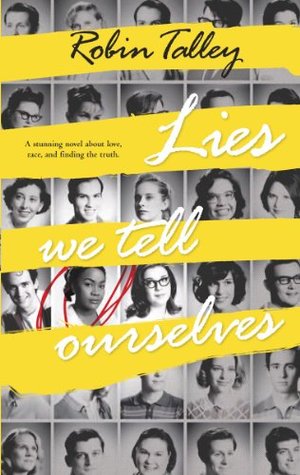
Review | Lies We Tell Ourselves by Robin Talley


by Robin Talley

My Rating: 

In 1959 Virginia, the lives of two girls on opposite sides of the battle for civil rights will be changed forever.

Sarah Dunbar is one of the first black students to attend the previously all-white Jefferson High School. An honors student at her old school, she is put into remedial classes, spit on and tormented daily.

Linda Hairston is the daughter of one of the town's most vocal opponents of school integration. She has been taught all her life that the races should be kept separate but equal.

Forced to work together on a school project, Sarah and Linda must confront harsh truths about race, power and how they really feel about one another.
Somehow Robin Talley has completely passed me by, though considering I don't read much YA nowadays I suppose I shouldn't be too surprised. It's not even that I don't read YA out of choice, I've just been drawn to a lot more adult fiction this year. I wanted to check out some of Robin's work after I discovered As I Descended, which is one of my most anticipated releases of 2016, and then I stumbled across her debut novel, Lies We Tell Ourselves, and just had to read it.

I haven't read many books set during the '50s - if any - so it was refreshing to read about a time period I don't stray into that often; I love historical fiction, but I'm drawn to earlier history much more than modern history, mainly because of my lifelong love of the Tudors. I also very rarely read books in which racial issues are such a focal point; again, this is not something I do out of choice, but something that just kind of... happens. The only books I can pluck from the top of my head that deal directly with racial issues are Malorie Blackman's Noughts & Crosses and Harper Lee's To Kill a Mockingbird and I've loved them both, so I guess that's proof that I should read more books like this one.

Lies We Tell Ourselves is difficult to read in the best kind of way. Does that make sense? The racism and abuse and outright cruelty that Sarah and her fellow black students, and the black population in general, face is sickening. It's awful to know that people were treated this way (and that, in some places, they still are) but stories like this one are so important. It's so important for us to remember the difficulties some people faced, and still face, purely because of the colour of their skin. I will never understand racism - I never want to understand racism - and I hope one day we'll see the day when colour no longer matters. If any of you think racism is a thing of the past, I implore you to open your eyes.

I really enjoyed Robin Talley's writing, particularly the sections in which Sarah thought about her relationship with God and whether or not God meant to make her feel the way she feels, whether the Bible says there's anything wrong with women loving other women, were so touching and beautifully written. To be honest I fell completely in love with Sarah - she's a wonderful heroine, and I just want to give her a hug.

This book also passed the Happy Lesbian Test - hooray! (If you're wondering what the hell I'm talking about, there's a trend in queer stories, whether they're in books, films, or on tv, where lesbian relationships almost always end in disaster. One of the women dies or they split up or one of them realises she's actually straight. It's bullshit.)

There were a few little niggles that meant I couldn't give the novel five stars. For me the ending seemed to wrap up very quickly; I was hoping for more of a climax, more of a 'BANG!'. Instead we were told a lot which was then never realised: for example, I was hoping for more of a confrontation between Linda and her awful father. I didn't want to see her getting hurt, but she seemed to get away from him very easily considering how hopeless she'd made her situation out to be, though I suppose a lot of Linda's issues were more insular than anything else.

I could also totally understand why Linda had feelings for Sarah, my little cherub, but I couldn't always understand why Sarah had feelings for Linda. I appreciated the idea that Sarah could argue with her and feel more like herself, and I really appreciated that Talley didn't write Linda as a super special snowflake who had none of her father's beliefs; she's had her father's views imposed on her all her life and people don't change their beliefs overnight. But she is racist. There's no denying that. Linda is racist and her racism gets people hurt. She does change her views - which is also an important message, because everyone makes mistakes and everyone deserves the opportunity to be given the time to develop and change their views; I said some stupid things when I was 18, too - but she is a racist when Sarah develops feelings for her, and though it wasn't entirely unbelievable I sometimes had a difficult time understanding why Sarah found her attractive in more than just a physical way when some of the things that came pouring out of her mouth were so ignorant and hurtful.

Ultimately, however, this is a brilliant debut novel and I thoroughly enjoyed it. I flew through it and I'm really looking forward to reading more of Talley's work!

Friday, 21 August 2015

Review | Fingersmith by Sarah Waters


by Sarah Waters

My Rating: 

No one and nothing is as it seems in this Dickensian novel of thrills and reversals. Sue Trinder is an orphan, left as an infant in the care of Mrs. Sucksby, a "baby farmer." Mrs. Sucksby’s household also hosts a transient family of petty thieves--fingersmiths--for whom this house in the heart of a mean London slum is home.

One day, the most beloved thief of all arrives--Gentleman, an elegant con man, who carries with him an enticing proposition for Sue: If she wins a position as the maid to Maud Lilly, a naïve gentlewoman, and aids Gentleman in her seduction, they all will share in Maud’s vast inheritance. 

With dreams of paying back the kindness of her adopted family, Sue agrees to the plan. Once in, however, Sue begins to regret her decision.

I'm not entirely sure how to begin this review. I've been wanting to read Fingersmith for the longest time and I just never got around to it. Then, last Christmas, I got the BBC adaptation on DVD and I'd heard great things about it as an adaptation, but there was no way I was going to watch it before I'd read the book. That might be one of the best literary decisions I've ever made, because if nothing else this book is an experience.

If I told you I started this book in March and finished it in August, you'd probably assume it was a bad book, but the truth is I just wanted to savour it. I easily could have read it in two or three days, but I wanted to drag it out and keep that suspense going, because this is the twistiest, turniest book I have ever read. I don't like to blow my own horn, but I'm pretty good at guessing what's going to happen in books and films, but this book blew me away. There's more than one big twist, and when the first one happened I was sat in bed sucking all the air from the room into my lungs I was that shocked. I wanted to talk to someone about it, but it was three in the morning.

If that's not the sign of a good book, then I don't know what is.

I loved everything about this book. I loved the setting, I loved the way it was written, and I loved the characters. Sue has quickly become a favourite of mine - I thought she was lovely and honest, despite being a thief, and one of those characters I just wanted to hug. It took me a little longer to warm to Maud because I wasn't sure what to make of her, but that's one of the things I love about Sarah Waters; she doesn't write characters, she writes people. Maud is complex and honest in a different way - perhaps brutally so - and I think the relationship between her and Sue is one of the best romances I've read in a while.

If you're unfamiliar with Sarah Waters, she primarily writes historical fiction with LGBT* characters at the centre, which is fantastic. What I love about the way she writes, though, is that the books are never about sexuality, at least not in the obvious sense; she doesn't write books about people coming to terms with their sexuality, she writes about relationships in the same way that heterosexual relationships are written about. When a woman falls in love with a man, she doesn't have to come out as straight. She isn't met with questions like: 'are you sure you're straight? Maybe it's just a phase', and Waters doesn't do that to her characters either.

I can't recommend this book enough. Whether you like historical fiction or not, give it a try. Sarah Waters might specialise in historical queer fiction, but they're never history books or books about being queer, they're books about ordinary people, like you and me, with extraordinary stories.

Friday, 24 July 2015

Sexuality in Harry Potter | Harry Potter Month


Throughout July, Micheline @ Lunar Rainbow Reviews and Faith @ GeekyZooGirl are hosting Harry Potter Month. You can find out everything you need to know about it here! 


As much as we love the Harry Potter series, I think we can all agree that it isn't perfect. I like names with meanings as much as the next person, but considering Remus Lupin's name basically translates to Wolf McWolf it's no wonder Fenrir Greyback bit him.

In recent years I've seen more and more people eager to know more about the LGBT* community at Hogwarts, which I think is wonderful. We've become much more aware of diversity in the literary world, and though we still have a long way to go we've certainly made some improvements.

I totally agree that when it comes to diversity, authors need to start saying that their characters aren't white or straight instead of just hinting at it. However, I can understand why sexuality isn't really discussed in the Harry Potter books: because it's not relevant to Harry's story.

After J.K. Rowling announced that Dumbledore was gay, something I think most of us picked up on upon reading the seventh book, there were some people who were disgusted because they're gross and homophobic, and there were some people who were angry because they felt as though she was simply jumping on the LGBT* bandwagon.

Though I could understand the anger amongst some members of the LGBT* community I wasn't sure it was entirely justified. In what way was Dumbledore's sexuality important to Harry's story? More to the point, what did J.K. Rowling have to do to 'prove' that Dumbledore was gay and that she wasn't just lying for the sake of a publicity stunt? Did people want her to be horribly stereotypical and portray Dumbledore wearing sparkly robes and gushing over musical theatre?

Dumbledore's sexuality wasn't at all important to Harry's story. In fact no one else's sexuality was important to the story which was why, in my opinion, J.K. Rowling never openly discussed anyone's sexuality in the books. That doesn't mean the books are perfect, but I don't think their lack of openly discussed sexuality makes them terrible books.

But just because a character's sexuality wasn't discussed doesn't mean they weren't there! I know that's completely contradictory to my earlier point, but I'd like to refer to the wise words of Cosima Niehaus:


When it comes to sexual diversity I think we need to see more characters outside of the straight and gay spectrum. I've never read a book in which a character has identified as bisexual, not for lack of trying, and I've certainly never read a book in which a character has identified as asexual, demisexual or pansexual. If you have any recommendations, I'd love to hear them!

So I've made a little list of some of the Harry Potter characters who I believe aren't heterosexual.

(I also really hope I don't end up offending anyone with this post. If you're part of the LGBT* community I'm not trying to portray non-heterosexuality as 'cool' or 'quirky', I genuinely read the characters below as queer.)

Albus Dumbledore


Okay, so this one we already know. Dumbledore is gay which, like I said before, is something I think most of us picked up on while reading Deathly Hallows. I've started to like Dumbledore less and less as I've gotten older because I'm really not sure he was the best teacher (or the best human being), but his and Grindelwald's story was heartbreaking.

Sirius Black


Personally I think Sirius is pansexual. Pansexuality is described as sexual attraction, emotional attraction and/or romantic love towards people of any sexuality or gender identity. Sirius has always struck me as an 'if I like it, I like it' kinda guy. He does his own thing, and always has done, that's why he ends up in Gryffindor and eventually ends up living with James after his own family disown him. Out of all the Marauders, I certainly think Sirius was the one who was most experimental with his sexuality.


Remus Lupin


I've always thought of Remus as bisexual. In the books we know he marries Tonks, but because J.K. Rowling herself has openly stated that werewolves are treated in much the same way that AIDS sufferers have been treated I refuse to believe that he's straight. The AIDS virus devastated the LGBT* community, particularly during the '80s and '90s, and Remus was a young man in the '80s. On a much less serious note I like me some Remus/Sirius just as much as I like me some Remus/Tonks...

Charlie Weasley


I have a huge crush on Charlie Weasley, and I'm also pretty sure that he's asexual. I'm not trying to say that people who never get married or have kids must be asexual, but J.K. Rowling once said something along the lines of 'he's more interested in dragons than women', and I've read him as asexual ever since. Perhaps he's also aromantic, though a person can be asexual without being aromantic and vice versa!

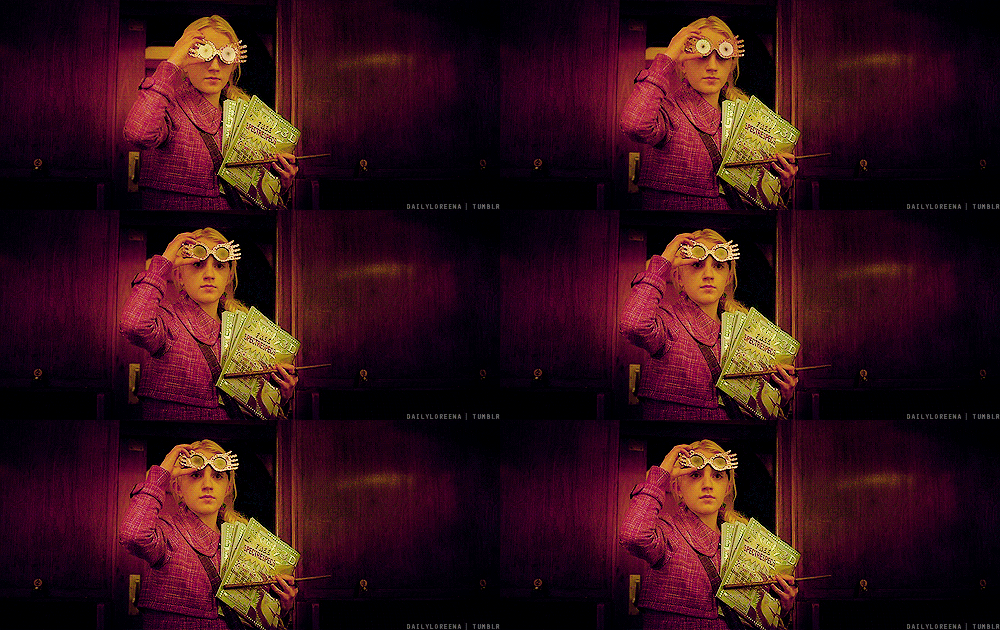
Luna Lovegood


This one I have no 'evidence' for, it's simply what I think: I read Luna as demisexual. People who are demisexual only feel sexually attracted towards people they already have an emotional and/or romantic bond with; it's often described as the 'grey area' between asexuality and bisexuality. There's something about Luna - she's serene to the core - that's always made me think of her as demisexual. I don't think of her as sexually experimental in the same way that Sirius is, but I can see her falling in love with a woman as easily as she'd fall in love with a man.


Do you read any of the Harry Potter characters as queer?