Showing posts with label queer fiction. Show all posts

Monday, 20 June 2016

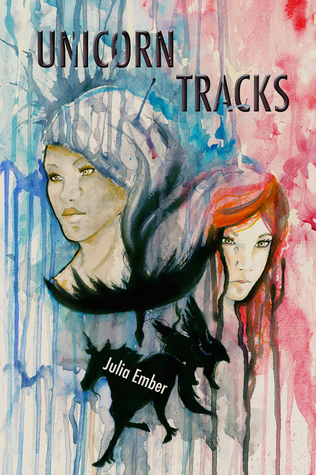
Review | Unicorn Tracks by Julia Ember


by Julia Ember

My Rating: 

After a savage attack drives her from her home, sixteen-year-old Mnemba finds a place in her cousin Tumelo’s successful safari business, where she quickly excels as a guide. Surrounding herself with nature and the mystical animals inhabiting the savannah not only allows Mnemba’s tracking skills to shine, it helps her to hide from the terrible memories that haunt her.

Mnemba is employed to guide Mr. Harving and his daughter, Kara, through the wilderness as they study unicorns. The young women are drawn to each other, despite that fact that Kara is betrothed. During their research, they discover a conspiracy by a group of poachers to capture the Unicorns and exploit their supernatural strength to build a railway. Together, they must find a way to protect the creatures Kara adores while resisting the love they know they can never indulge.

If you somehow didn't already know, I love unicorns. I also love stories that feature leading LGBT+ ladies. So when I discovered that Julia Ember's debut novel combined these two things, I knew I had to have it.

I've had the pleasure of speaking to Julia Ember quite a bit on Twitter and she's absolutely lovely, as is her debut.

Unicorn Tracks takes place in a world not entirely unlike our own where fantastical creatures are the norm. It's common for tourists to travel to Nazwimbe to go on safari and see everything from mermaids to phoenixes, but unicorns are somewhat rarer, so when safari guide and tracker Mnemba is given the job of leading a researcher and his daughter, Kara, into the wilderness in search of unicorns she has a real challenge on her hand, especially when they discover that unicorns are going missing.

Mnemba and Kara decide to investigate and stumble into something much bigger than they anticipated, all while trying to resist the growing attraction between them.

I love the ideas behind Unicorn Tracks; as far as I'm concerned there are way too few unicorns in fiction, and I mean that in all seriousness. There are classics like The Last Unicorn and they pop up in series such as Harry Potter, but they're very rarely included as a main feature in a story, especially if said story isn't aimed at children. There are dragons, vampires, werewolves, mermaids and faeries everywhere, but unicorns have been left behind.

What I love about Unicorn Tracks is this completely new take on unicorns; I've never seen them in anything but a European/European-inspired setting, so to place them as safari animals in a country that I'm assuming is an alternate Zimbabwe is such an original idea and I loved it. I mean if I could go on safari and see unicorns I so would, and I'd never want to leave.

Ember's characters are a lot of fun, too. Through Mnemba and Kara, Ember explores themes of forgiveness, choice and cultural differences, and I really appreciated that this is a book with an LGBT+ relationship at its centre that isn't about the characters' sexuality. 

The only thing I wanted from this book was more. I think Unicorn Tracks could have benefited from being longer, as there'd be more time to discuss everything Ember has included; the story, and Mnemba and Kara's relationship in particular, felt a little too rushed for me. There's so much here that's great, so I would have loved even more scenes of Mnemba and Kara exploring the wilderness and encountering even more mythological creatures.

What's most exciting about Unicorn Tracks is what else we can expect from Ember as an author. We need more voices in fiction that don't treat LGBT+ characters like parables of what it means to identify as queer, but instead write fun, exciting stories where the characters just so happen to be LGBT+.

I'm looking forward to whatever Ember does next!

Tuesday, 15 March 2016

From Screen to Page #3

Today I'm back with another From Screen to Page post! For any of you unfamiliar with these posts, From Screen to Page is a feature in which I recommend a piece of historical fiction I think people will like if they like whichever film I happen to be talking about. For example, in my very first post I recommended Maeve Haran's The Lady and the Poet to anyone who's a fan of Shakespeare in Love.

It's been a while since I last did one of these - check out #1 and #2! - and today I'm going to do something a little different: instead of recommending a book that's like a film, I'm going to recommend a book that's nothing like a film at all. Why? Because Grease is kind of awful.

*ducks*

... Is it safe to come out now?

Now when I say Grease is awful, I don't mean it's an awful musical. It's not my favourite - I like my musicals a bit more epic, like The Lion King and Les Mis - but there's no denying that it's a fun musical. People pop out of the womb already knowing all the words to pretty much every song, and because it's been a favourite for so many years, thanks to the 1978 film, it's the kind of story that entire families will sit down to watch together at Christmas. Kids love the songs, parents remember watching it when they were young, and grandparents can remember those unfortunate hairstyles.

There's actually a lot about the story that I like. I think Danny Zuko is quite a charming hero, struggling to maintain his reputation as the high school bad boy while also falling head over heels for a girl who doesn't quite fit into his circle of friends, and I love Rizzo who, in my opinion, is one of the most complex and interesting characters in the musical.

My biggest problem with the story is the way it treats Sandy. I'm all for coming of age stories, including coming of age stories set at high schools, but Sandy's story concludes with her being rewarded with her happy ending because she essentially changes everything about who she is. I'm not suggesting that because she smokes and puts on some leathers she's no longer the same kind, innocent girl, but there's something about a girl who changes that much for the sake of a boy that makes me sad. 

Grease is set in 1958, and Robin Talley's debut novel, Lies We Tell Ourselves, is set a year later in 1959, with a very, very different atmosphere.

While there are some similarities between Grease and Lies We Tell Ourselves in that they're both set at high school in the '50s, and both feature a love story between two people from very different social circles, they're not alike at all. Lies We Tell Ourselves tackles racism in the mid-20th century, and in particular how black students struggled when they were finally admitted to better, previously all-white schools.

It's one of those books that'll just hit you right where it hurts, because it's so difficult to think that human beings were treated in this way. It's even more difficult to think that many are still being treated in this way.

Sarah Dunbar is one of the first black students to be admitted to her previously all-white local high school, and the novel follows her as she battles racism on a daily basis and also tries to understand her sexuality. Everything becomes even more complicated when she meets and develops feelings for Linda Hairston, a white girl whose father is a huge bigot.

If you want to know my thoughts on the book then you can check out my review here. From what I've said I think you can gather that other than the '50s setting and vaguely Romeo and Juliet style romance there are practically no similarities between Grease and Lies We Tell Ourselves, but that's no bad thing. Lies We Tell Ourselves is the perfect story if you want to read a story set in the '50s that actually deals with issues from the '50s beyond who's taking who to the dance. It's a powerful debut from a much-needed voice in the world of YA, and one that challenges the fairly problematic way that Grease portrays the '50s, where's there's not a poc in sight and oh wasn't everything just smashing?

For me Lies We Tell Ourselves is like a version of Grease where Sandy falls in love with Rizzo, and the musical numbers are replaced by explorations of racism and sexuality. If that sounds more like the kind of story you want set in the '50s, then you need to pick up this book!

How do you feel about Grease?

Friday, 18 December 2015

Review | Tipping the Velvet by Sarah Waters


by Sarah Waters

My Rating: 

This delicious, steamy debut novel chronicles the adventures of Nan King, who begins life as an oyster girl in the provincial seaside town of Whitstable and whose fortunes are forever changed when she falls in love with a cross-dressing music-hall singer named Miss Kitty Butler. 

When Kitty is called up to London for an engagement on "Grease Paint Avenue", Nan follows as her dresser and secret lover, and, soon after, dons trousers herself and joins the act. In time, Kitty breaks her heart, and Nan assumes the guise of butch roue to commence her own thrilling and varied sexual education - a sort of Moll Flanders in drag - finally finding friendship and true love in the most unexpected places.

Check out my reviews of Affinity, Fingersmith and The Little Stranger!

I've been slowly but surely making my way through Sarah Waters' novels; I'd already read Affinity, Fingersmith and The Little Stranger, so when I was in the mood for another Sarah Waters story I thought it was about time I picked up her debut. I'm sad to report that this is probably my least favourite of Waters' novels so far, but that doesn't mean I didn't like it.

Firstly, I think having read Fingersmith and The Little Stranger this year and adoring them both - I loved The Little Stranger an unbelievable amount - I couldn't go into Waters' debut with huge expectations because, as with most writers, her skill as a storyteller has improved with each novel. So far she's published six novels, The Paying Guests being her most recent release, and this year I read her third and fifth novels, so to go back to her first is quite a jump.

For anyone unfamiliar with Sarah Waters, she writes primarily queer historical fiction; five of her six published novels have queer female protagonists, and even the main female protagonist of The Little Stranger can be read as queer if you like. In terms of sexual diversity in historical fiction, Sarah Waters is a fantastic voice, and with Tipping the Velvet she burst into the literary world with an action-packed, steamy lesbian romp of a novel.

Something I must say is that, of the novels I've read so far, Tipping the Velvet is the most sexually explicit, the title itself is Victorian slang for cunnilingus, so if that kind of thing makes you uncomfortable I'd definitely recommend you stay away from this one. There's a lot of sex in this book; I don't think it's gratuitous, the novel itself is basically a young girl's sexual coming (pardon the pun) of age story, but it's certainly a large part of the book so if you do find reading about sex uncomfortable I don't think this book is for you.

One of the things I loved most about Tipping the Velvet was how I couldn't have possibly guessed what was going to happen. It begins in the small town of Whitstable where eighteen year old oyster girl Nancy Astley sees Kitty Butler, a cross-dressing music-hall singer, performing at her local theatre and falls hopelessly in love with her. The story moves quickly; before we know it Nancy has followed Kitty to London as her dresser, and her story progresses from there and turns into a different story every few chapters. There is such a difference between the opening chapter and the final chapter, and I got the sense that Waters had a lot of fun writing this book.

The book actually takes place over a number of years; by the end of the novel Nancy is twenty-four, and she certainly has a lot of adventures in those six years. Sarah Waters has said that some of her favourite books to read are classic Victorian novels, and Tipping the Velvet feels like a tip of the hat to all those classic novels which were initially serialised; Nancy goes through so much that I could imagine her story being told in small, dramatic installments over a few months.

I did enjoy this novel, but I didn't love it, and that's mainly because of Nancy. I wouldn't say I disliked Nancy - in the world of historical fiction she's a very interesting heroine - but I found it hard to relate to her, and some of the decisions she made had me wanting to shake her. She frustrated me a lot more than the other heroines I've encountered in Waters' stories, and if I don't completely like a main character I'm not going to love her story. Plus, as I mentioned above, Tipping the Velvet is her debut novel, and I didn't think it was quite as accomplished as some of her later work in terms of the way it's written; because it's all written in hindsight, with an older Nancy telling us her story, I found some sections of it to be told a lot more than shown, so I couldn't immerse myself in the story as much as I could with some of her other novels.

That being said, there are so many books out there about men having lots of sex and treating women terribly and 'finding themselves' that it was really refreshing to read a book about a woman who has more than one sexual partner, and doesn't apologise for it. Ultimately I think I liked what this story was doing more than the story itself, but I did like it even if I didn't like it as much as some of Waters' other work.

I'm glad I read it, though, and I'm looking forward to crossing The Night Watch and The Paying Guests off my TBR in the new year!

If sex doesn't bother you and you want to try out some of Waters work then, with this being her debut, I think Tipping the Velvet is a good place to start. If not, personally I think one of the best ways to introduce yourself to Waters' work is to read Fingersmith.

Friday, 21 August 2015

Review | Fingersmith by Sarah Waters


by Sarah Waters

My Rating: 

No one and nothing is as it seems in this Dickensian novel of thrills and reversals. Sue Trinder is an orphan, left as an infant in the care of Mrs. Sucksby, a "baby farmer." Mrs. Sucksby’s household also hosts a transient family of petty thieves--fingersmiths--for whom this house in the heart of a mean London slum is home.

One day, the most beloved thief of all arrives--Gentleman, an elegant con man, who carries with him an enticing proposition for Sue: If she wins a position as the maid to Maud Lilly, a naïve gentlewoman, and aids Gentleman in her seduction, they all will share in Maud’s vast inheritance. 

With dreams of paying back the kindness of her adopted family, Sue agrees to the plan. Once in, however, Sue begins to regret her decision.

I'm not entirely sure how to begin this review. I've been wanting to read Fingersmith for the longest time and I just never got around to it. Then, last Christmas, I got the BBC adaptation on DVD and I'd heard great things about it as an adaptation, but there was no way I was going to watch it before I'd read the book. That might be one of the best literary decisions I've ever made, because if nothing else this book is an experience.

If I told you I started this book in March and finished it in August, you'd probably assume it was a bad book, but the truth is I just wanted to savour it. I easily could have read it in two or three days, but I wanted to drag it out and keep that suspense going, because this is the twistiest, turniest book I have ever read. I don't like to blow my own horn, but I'm pretty good at guessing what's going to happen in books and films, but this book blew me away. There's more than one big twist, and when the first one happened I was sat in bed sucking all the air from the room into my lungs I was that shocked. I wanted to talk to someone about it, but it was three in the morning.

If that's not the sign of a good book, then I don't know what is.

I loved everything about this book. I loved the setting, I loved the way it was written, and I loved the characters. Sue has quickly become a favourite of mine - I thought she was lovely and honest, despite being a thief, and one of those characters I just wanted to hug. It took me a little longer to warm to Maud because I wasn't sure what to make of her, but that's one of the things I love about Sarah Waters; she doesn't write characters, she writes people. Maud is complex and honest in a different way - perhaps brutally so - and I think the relationship between her and Sue is one of the best romances I've read in a while.

If you're unfamiliar with Sarah Waters, she primarily writes historical fiction with LGBT* characters at the centre, which is fantastic. What I love about the way she writes, though, is that the books are never about sexuality, at least not in the obvious sense; she doesn't write books about people coming to terms with their sexuality, she writes about relationships in the same way that heterosexual relationships are written about. When a woman falls in love with a man, she doesn't have to come out as straight. She isn't met with questions like: 'are you sure you're straight? Maybe it's just a phase', and Waters doesn't do that to her characters either.

I can't recommend this book enough. Whether you like historical fiction or not, give it a try. Sarah Waters might specialise in historical queer fiction, but they're never history books or books about being queer, they're books about ordinary people, like you and me, with extraordinary stories.

Monday, 16 March 2015

2015 Forgotten Histories Reading Challenge! | Week 3


It's week three of the Forgotten Histories Reading Challenge, and this week's challenge is to read a book with an LGBT protagonist.

Below are a list of books for any of you who are unsure as to which book to read. Don't forget to enter my giveaway!


by Sarah Waters

by Emma Donoghue

by Sarah Waters

by Kate Worsley

by Sarah Waters


by Diana Gabaldon

by Jane Eagland

by Tom Spanbauer

by Virginia Woolf

by Mary Renault