Showing posts with label ya fiction. Show all posts

Monday, 27 July 2015

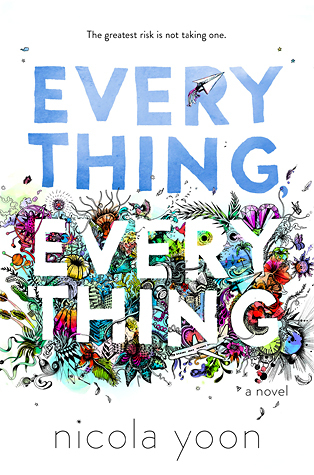
Review | Everything, Everything by Nicola Yoon


by Nicola Yoon

My Rating:


My disease is as rare as it is famous. Basically, I’m allergic to the world. I don’t leave my house, have not left my house in seventeen years. The only people I ever see are my mom and my nurse, Carla.

But then one day, a moving truck arrives next door. I look out my window, and I see him. He’s tall, lean and wearing all black—black T-shirt, black jeans, black sneakers, and a black knit cap that covers his hair completely. He catches me looking and stares at me. I stare right back. His name is Olly.

Maybe we can’t predict the future, but we can predict some things. For example, I am certainly going to fall in love with Olly. It’s almost certainly going to be a disaster.

I received a copy of Everything, Everything from Netgalley in exchange for an honest review.

Everything, Everything follows the life of Maddy who has an incredibly rare illness which means that she's basically allergic to, well, everything. If she went outside she'd probably die. She's never been able to make real friends her own age or go to school or learn to drive or go on a date. Then a new family moves in next door, and Maddy meets Olly...

What an easy read this was! I sped through Everything, Everything, which was just what I needed because, before I picked it up, I could feel myself falling into a post-amazing book slump after I finished Katherine Addison's The Goblin Emperor. Maddy's narrative voice was so easy to fall into, and I loved her sense of humour. I wasn't sure what someone who's allergic to everything would be like, but Maddy was rarely self-pitying or bitter, even though she had every right to be, nor was she a saint. She was an ordinary girl, who also just happened to be ill.

This is quite possibly one of the most diverse books I've ever read, though considering Nicola Yoon's own feelings for the #WeNeedDiverseBooks campaign I'm not all that surprised. Maddy is mixed race; half of her ancestry is Asian (Japanese, I think?) and the other half is African American. I haven't read a single book starring another character with that background, so that was fantastic. And there wasn't only Maddy; Maddy's mother, her nurse, and Olly's friend were all people of colour, which is awesome.

The best thing about it, though, was that it didn't feel like Yoon was trying to do a racial paint by numbers. It never felt as though she was including these people 'just to be diverse', but that she was including these people because when she looks at the world it isn't, and never has been, all white. I loved that.

I thought the romance in Everything, Everything was believable and really quite lovely. Maddy and Olly were great together, but they were also great separately, too, which doesn't always happen when you get stories in which the romance is one of the main aspects rather than a sideplot. I could understand why the two of them fell so deeply in love with one another and, perhaps more importantly, I as a reader was hoping for their happiness.

The only thing I had a problem with was that some aspects of the story felt too easy. For example, I would have liked to have known more about Olly's sister and I feel like the only reason we didn't see more of her is because it was easier to just not write about her. Does that make sense? There is also something that happens near the end of the novel that I did kind of like, it's certainly interesting and quite suspenseful, but then it's also a little unbelievable, and another part of me can't help feeling that perhaps Yoon didn't know how else to end it, and so she ended it the way she did. That's so unhelpful, I know, but it's impossible to talk about the thing I'm talking about without spoiling the novel.

All in all, I did enjoy this. For a debut novel it's pretty good! Contemporary isn't the genre I usually lean towards, but I sped through this in two sittings, and definitely recommend it to anyone who's been eying it up.

Tuesday, 16 December 2014

My End of Year YA TBR | Twelve Days of Christmas!

I don't think I'd ever say I've grown out of YA because I don't think it's possible to grow out of a genre that isn't meant for just teenagers/young adults anyway. I'm 23 now. I might not be as young as I was when I was 17, but I certainly still think of myself as a young adult rather than an old one.

But I'm absolutely rubbish at keeping up with the latest trends and newest releases in YA, and over the past couple of years my tastes have simply meant that I've been reading more adult books anyway. There are YA releases from two years ago that I still haven't gotten around to reading - never mind the ones from this year! - so as the end of the year approaches, here are some pieces of YA I'd like to try and cross off my TBR before 2015!
 
The Raven Boys by Maggie Stiefvater: This is the book I'm most eager to cross off my TBR. It feels as though every single book blogger I know has read and loved this series, and frankly I'm tired of feeling left out. I've actually already started this book, and enjoying what I've read so far, so with any luck I'll have it under my belt soon!

Half Bad by Sally Green: I love stories about witches, and I've owned my copy of Half Bad for a while now (though not as long as another book on this list) so it's really about time I read it, especially with the second book in the trilogy, Half Wild, being released in March!

Red Rising by Pierce Brown: In all honesty I initially had no intention of reading Red Rising when I first started seeing it popping up all over the blogosphere, but lately I've been hearing so many great things about it that I want to check it out for myself. Not only that, but lately I've also been getting into sci-fi - a genre that used to intimidate me hugely - so I'd love to expand my sci-fi knowledge just a little bit. I've seen a copy of this in my local library, so with any luck I'll be able to read it soon. Plus, like Half Bad, the second book in this trilogy, Golden Son, is due to be released in early 2015!

The Host by Stephenie Meyer: Behold, one of the longest unread books on my shelf. My sister bought me a copy of The Host when it first came out - I was still a Twilight fan then and I wanted Meyer's new book badly - then I got my wake up call that Twilight is actually a pretty dangerous series, because if you don't just laugh it off and decide to take it seriously what it's really saying is 'you are worth nothing without a boyfriend'. After that I felt less inclined to read Meyer's other book, but even friends of mine who despise Twilight have admitted that The Host isn't half bad (ha, see what I did there?). Ultimately I've owned this book for six years and I really need to read the poor thing.

Do you have any end of year reading goals?

Monday, 13 October 2014

Review | Blood Sinister by Celia Rees


by Celia Rees

My Rating: 


Ellen Forrest is sick, she feels as if the life is being sucked out of her. The doctors think that she is suffering from a disease of the blood, and she has been sent to her grandmother's house to rest, but she seems to be getting worse, not better. Can it have anything to do with the diaries she has found in the attic? Diaries written in Victorian times by her great great grandmother. Diaries that describe an encounter with a handsome young Count who comes from the Land Beyond the Forest. 

Ellen likes a vampire story, who doesn't? The difference is that this one just happens to be true…

Celia Rees was the first author to whet my appetite for historical fiction during my early teens, and I’ve been lucky enough to meet her more than once through Litfest. It was during a Litfest event all about Gothic YA Fiction that I first came across Blood Sinister.

Both our protagonists in Blood Sinister share the name Ellen. In the 1990's we have Ellen Forrest, a sixteen year old who is very ill with a blood disease her doctors have been unable to diagnose and are struggling to treat, and in the 19th century we have Ellen Laidlaw, her great great grandmother, who is the daughter of a doctor well known for his advancements in the treatment of blood diseases. Their stories collide when Ellen Forrest discovers her great great grandmother's diaries, written when she was sixteen, detailing the strange events that followed the arrival of a pair of mysterious family friends with an aversion to sunlight...

It was a short, quick read which was just what I was in the mood for, but sadly it was nothing spectacular. It's forgettable, with a rather weak ending, and for someone who's loved Rees's works for so long that was a disappointment.

Having said that, there were elements of the story that were a lot of fun. Rees played around with vampire stereotypes; stereotypes she could play around with because Ellen Laidlaw lived and wrote her diaries before the publication of Bram Stoker's Dracula, therefore it was believable that she and her friends and family would never even think to suspect their mysterious guests of vampirism.

I thought it was a wise choice to give the story two protagonists, though I'm still undecided as to whether or not I liked that they were both called Ellen. Historical fiction is one of the most common genres in which you'll find novels with two protagonists; setting one character in the past and another either in or nearer to the present day, who is usually researching the person from the past, is a good way to involve people in the story who are unfamiliar with historical fiction. A lot of people think they need to be a history expert to enjoy historical fiction, and that's just not true.

(If you are one such person and you'd like to read some historical fiction that is told through the eyes of two protagonists, then give Sebastian Faulks' Birdsong, Katherine Howe's The Physick Book of Deliverance Dane, and Kate Mosse's Labyrinth a try!)

However, both Ellens were also forgettable. I didn't dislike them, but I didn't connect with them or particularly care if they lived or died either. It was great to see, through Ellen Laidlaw, a 19th century heroine pursuing medicine and being supported in that pursuit, but sadly it was this Ellen who also suffered from "not like other girls" syndrome. She was better than the other women around her, who only cared about marrying well and having babies and looking pretty, and I really dislike women who are portrayed this way. There's nothing wrong with wanting to marry well, have babies or look pretty, just as there's nothing wrong with wanting to pursue medicine, and I'd like to see more heroines in fiction - particularly YA fiction - who are aware of this.

Blood Sinister is just okay. It's unlikely to be something I remember in a year's time, but for a quick, tongue-in-cheek Halloween read it was fun, and despite my lower rating I'd recommend it to anyone out there who's looking for something fast and easy to read as Halloween approaches!

J.

Friday, 16 May 2014

10 Books That Changed Me | Witch Child by Celia Rees

Continuing with the history theme from last month, this month I'm going to talk to you about Celia Rees's Witch Child.

I first read Witch Child when I was around 12/13 years old, and I can still remember picking it out from amongst the other books on the shelves when I saw it. There's something so haunting and enticing about the photograph on the cover that immediately drew me in.

I don't think I purchased it the first time I saw it, but each time I went into the book shop I kept making eye contact with this book, and I kept picking it up and reading the blurb and feeling the weight of it in my hands.

It wasn't just the physical book that interested me, but the story inside. As I've mentioned many times before I've always loved history, but I never really read that much historical fiction, and I think that's because, when I was younger at least, there weren't many pieces of historical fiction out there for younger readers. I'm sure there were, I just couldn't find them; when I was younger the Teen section wasn't full of all the fun, dark YA reads we have now, it was full of pink books about pretty teenagers who had spots and wanted boyfriends.

I'm not at all trying to shame people who enjoy reading those kinds of books - the contemporary romance books of today - they just weren't what I was interested in. I never grew out of my love for history and fantasy and horror. I didn't want to grow up and read about people in the real world; the real world was the place I was trying to escape from.

Eventually my parents bought me a copy of Witch Child and I adored it. In fact I'm pretty sure I reread it several times because one time just wasn't enough. Like the book I mentioned last month, this book made history approachable for me and other people my age, not by making history gruesome but by helping me to see history through the eyes of another teenage girl. Historical fiction became something I could access, too, it wasn't just for adults.

This is the book that first got me into historical fiction; in fact I think its influence on me is obvious even now, given that I'm currently working on a historical fiction novel that deals with the subject of witchcraft!

I'm 22 now, and I still recommend this book to other people. If I ever have a daughter of my own I'm going to encourage her to read it, too.

Which book do you remember most from your early teens?

Monday, 5 May 2014

#WeNeedDiverseBooks | Whitewashing and YA

Before I say anything I'm going to say that these are just my personal thoughts. I am by no means an expert on racial issues and it's not my intention to insult or offend anyone, I'm just adding my own thoughts to the debate!

Over the weekend #WeNeedDiverseBooks trended on Twitter as authors, publishers, librarians and readers from all over the world talked about why diversity in literature - and in children's literature in particular - is important. You can find an article about it here!

So I thought today would be the perfect opportunity for me to talk about my thoughts concerning whitewashing and YA.

The majority of us, if asked, will say that we're not racist, and while I don't think most people who say that are lying it is possible to be racist without realising; especially if, like me, you're white. Most of us who are white don't tend to realise just how privileged we are.

I'm not trying to lecture anyone, and I'm certainly not trying to demonise white people. I'm a white person myself, and I think it's ridiculous to say that because someone's white they're therefore a horrible person, but I do think more of us need to realise just how underrepresented people of colour are.

YA today is fantastic at giving minorities - and I hate to use the word 'minorities' - a voice. Not only is YA well known for giving readers brilliant female characters who are more than just 'the love interest' or 'the sidekick', but many of these characters also happen to be people of colour.

So why haven't publishers and film makers noticed this?

Take The Hunger Games, for example. Katniss Everdeen is one of the best heroines to grace YA today; she's flawed, brave and loving. She's also olive-skinned, though the film franchise would have you believe otherwise. In fact fans of the series who only watch the films and don't read the books might have no idea that Katniss is a woman of colour at all.

Don't get me wrong, I love Jennifer Lawrence; I think she's fantastic as Katniss, but she is white. Other than Lawrence, several other actresses were considered for/interested in the role: Kaya Scodelario; ChloĂ« Grace Moretz; Emma Roberts; Saoirse Ronan; Emily Browning and Shailene Woodley just to name a few.

Is it just me, or are all of those actresses white?

In her own words, author Suzanne Collins said: "In her remarkable audition piece, I watched Jennifer embody every essential quality necessary to play Katniss." (You can find the rest of that article here).

If the author's happy with the choice then I suppose the rest of us should be too. Collins knows Katniss better than any of us could ever hope to, and as I said before I do think Lawrence is a brilliant Katniss, but how do they know they wouldn't have found the qualities they were looking for in an olive-skinned actress if they didn't audition any?

Sadly it's not only the film industry that whitewashes its characters, the publishing industry does too; it's notorious for putting a white model on the cover of a book which features a non-white protagonist. Perhaps one of the most shocking examples of this is the cover of the first book in Julie Kagawa's Blood of Eden series, The Immortal Rules.

This series, set in a post-apocalyptic future where vampires roam the earth, features a heroine named Allison Sekemoto. If her surname isn't enough of a clue, Allison is Asian. Fantastic! I can't remember the last time I stumbled across a book with an Asian protagonist.


Hm. I don't know what's worse: that the cover designer didn't read the book and assumed the heroine was white, or that the cover designer did read the book and put a white model on the cover anyway.

(I have nothing against the model, of course, she's very pretty, I just don't think she's quite how readers picture Allison).

I wish I could say The Immortal Rules is the only example of a publisher choosing the wrong cover model, but sadly it happens a lot.

Let's look at Maria V. Snyder's Poison Study, the first book in her Study series. This particular series follows Yelena Zaltana, a young woman who is thrust from deathrow into a new job as the Commander of Ixia's food-taster. As far as Yelena knows she's an orphan from Sitia, the land that lies South of Ixia and is known for its magic-users and its warmer climate.

In the book it's mentioned that people from Sitia tend to have darker skin than those in Ixia, thus leaving Yelena's skin tone unspecified - meaning people can imagine her to be olive-skinned like Katniss or black like Malorie Blackman's Sephy in Noughts and Crosses - but one thing we know for certain is that she is not white.

And yet, once again, we are left with a white cover model. More than once.

Why are publishers so afraid of putting people of colour on the covers of their books? I refuse to believe that books featuring people of colour won't sell because there is an audience for books featuring such characters. Personally I don't care what the colour of the protagonists's skin is - I'll read anything! - and the majority of other readers I come across feel the same.

Representation matters, and both people of colour and white people should be on our book covers. The world is made up of so many different races that in this day and age it's ridiculous that we still think it a novelty to see people of colour in the media.

What are your thoughts on the matter?


J.

Friday, 25 April 2014

Review | Strands of Bronze and Gold by Jane Nickerson


by Jane Nickerson

My Rating: 

When seventeen-year-old Sophia Petheram’s beloved father dies, she receives an unexpected letter. An invitation—on fine ivory paper, in bold black handwriting—from the mysterious Monsieur Bernard de Cressac, her godfather. With no money and fewer options, Sophie accepts, leaving her humble childhood home for the astonishingly lavish Wyndriven Abbey, in the heart of Mississippi.

Sophie has always longed for a comfortable life, and she finds herself both attracted to and shocked by the charm and easy manners of her overgenerous guardian. But as she begins to piece together the mystery of his past, it’s as if, thread by thread, a silken net is tightening around her. And as she gathers stories and catches whispers of his former wives—all with hair as red as her own—in the forgotten corners of the abbey, Sophie knows she’s trapped in the passion and danger of de Cressac’s intoxicating world.

Jane Nickerson's Strands of Bronze and Gold falls into several categories: it's a piece of YA, a piece of Historical Fiction, and a fairy tale retelling all rolled into one.

It was an interesting take on the Bluebeard myth; I haven't read any other retellings of that particular story, nor do I think I've ever read anything set in the "Deep South", so that's something I'll have to change!

In this retelling, seventeen year old Sophia "Sophie" Petheram travels to live with her godfather, the wealthy Monsieur Bernard de Cressac, after the death of her father. All her life he has sent her lavish gifts, and when she arrives at his estate he spoils her. Soon, however, Sophie realises there is a much more sinister side to her godfather than she ever could have imagined.

Before I say anything else, there will be spoilers in this review, so please don't read on if you haven't read this book yet - I don't want to be responsible for ruining it for you!

Personally I felt as though de Cressac, our Bluebeard, was too obviously dodgy from the start. Perhaps it's because I'm familiar with the Bluebeard myth (though I believe many people are) but I just couldn't understand how Sophie wasn't more suspicious of him sooner. After all, when she arrives she discovers that not only has he failed to mention that his wife has died, but that he's managed to get through four wives, all with red hair like her own.

Having said that, when Sophie did finally come to the conclusion that de Cressac had murdered his previous wives she came to it far too quickly. I'm not trying to say that finding six human teeth in your godfather's bedroom is normal, but in reality they could have been anyone's! I was hoping the book would build up with a slow, sizzling tension before Sophie finally found the bodies of the previous wives in de Cressac's chapel. In the original myth I'm fairly certain the heroine doesn't know for certain that her husband is a murderer until she finds the bodies.

Sophie herself I found a little boring at first, but as the novel wore on she developed much more of a personality of her own. One thing I really loved about her, though, was that Nickerson didn't try and make her 'bad ass' to pass as a YA heroine. She's very feminine and 'girly', but that doesn't mean she doesn't possess a different kind of strength to the strength of, say, Katniss Everdeen. Personally I think we need more feminine heroines in YA - a heroine shouldn't have to adopt stereotypical masculine traits to be taken seriously as a protagonist!

Sophie is also one of the few, if only, YA heroines I've read who's openly acknowledged a faith of some kind. I'd describe myself as agnostic, but I love that Sophie isn't apologetic for her belief in God, in the same way that she isn't apologetic for being feminine. I can understand why there isn't a huge amount of religion in YA - at least not that I've come across - because it can alienate some readers from the book, but personally I find religion fascinating; if it's used tastefully, and not as a way to try and convert readers, then there's no reason why we shouldn't see more of it in YA.

In fact religion is such a big part of Sophie's life that her love interest is a preacher! I quite liked Gideon; he was the complete opposite of de Cressac, and sweet in a dorky, 'boy next door' kind of way, which was a refreshing change for me. Lately all of the YA I've come across has involved love interests who are dark and/or brooding in one way or another. 

However, at times he and Sophie almost felt too good. I expected the retelling as a whole to be quite a bit darker than it was given its original source material; I honestly expected Sophie to marry de Cressac a little earlier in the novel and then discover his awful secret. This would have been a nice change from all of the YA in which the heroine meets her 'true love' when she's still innocent and virginal and all those things which, sadly, we associate with young women.

I did love, however, that Nickerson chose not to have Gideon or one of Sophie's siblings save her from de Cressac; instead he ultimately got caught in one of his own traps. A small part of me wanted Sophie to kill him herself, but if we're being honest she doesn't seem like the kind of heroine who could kill anyone, and there's nothing wrong with that! I'd rather have an ending where the protagonist's actions were believable than sit back and watch them do something I couldn't imagine them doing.

Though I enjoyed the book on the whole I was still left with some unanswered questions at the end. For example we never really found out how de Cressac came to be Sophie's godfather in the first place; a few times it's mentioned that he had a fondness for her mother, whom Sophie takes after, but his relationship with her parents is never really expanded upon.

I also would have liked to see more of Odette, Sophie's handmaid and eventual friend. I guessed quite early on in the book that she was some sort of relation to one of de Cressac's previous wives, and I wanted to know more about this woman who'd had the guts to enter this dangerous man's house and investigate for herself. In fact I was rather disappointed that Nickerson chose to kill her; I think she had a lot of potential as a character.

The issues concerning slavery also seemed a little too ghosted over for my liking. I appreciated that Nickerson chose to include it in the novel, especially as it is a piece of Historical Fiction, but sometimes it felt as though she'd put it there as an afterthought; as though she'd just remembered that black people were enslaved in the South of America at this time.

There were a few times in which Sophie even compared herself to the slaves who worked for de Cressac, and while I certainly felt sorry for Sophie and the dire situation she was in, I'm fairly sure de Cressac's slaves suffered more than she did.

That being said, the end of the novel was full of hope for the future. I loved that Sophie inherited her godfather's wealth and that she intended to use it to free and help de Cressac's slaves, and I appreciated that, though she agreed to marry Gideon, she would do so in a year or so after she'd had more of a chance to enjoy her independence. 

All in all it was an interesting retelling. I liked it enough to read all of it; it's not the best writing I've ever come across, some sections were a little melodramatic, but I recommend it to anyone who likes retellings. I'll definitely pick up Nickerson's next retelling, The Mirk and Midnight Hour, some time in the future.

J.

Friday, 18 April 2014

Review | Cress by Marissa Meyer


by Marissa Meyer

My Rating: 

Rapunzel’s tower is a satellite. She can’t let down her hair—or her guard. 

In this third book in the bestselling Lunar Chronicles series, Cinder and Captain Thorne are fugitives on the run, with Scarlet and Wolf in tow. Together, they’re plotting to overthrow Queen Levana and her army. 

Their best hope lies with Cress, who has been trapped on a satellite since childhood with only her netscreens as company. All that screen time has made Cress an excellent hacker—unfortunately, she’s just received orders from Levana to track down Cinder and her handsome accomplice. 

When a daring rescue goes awry, the group is separated. Cress finally has her freedom, but it comes at a high price. Meanwhile, Queen Levana will let nothing stop her marriage to Emperor Kai. Cress, Scarlet, and Cinder may not have signed up to save the world, but they may be the only ones who can.

In the third book of The Lunar Chronicles, Marissa Meyer puts a whole new spin on the story of Rapunzel. Meyer's Rapunzel - Cress - is a fantastic hacker who has been kept in a satellite since she was small by Mistress Sybil, Queen Levana's right hand woman. 

She has been given the task of tracking down Cinder and her accomplices, but instead of revealing their whereabouts she has been hiding them instead, and admiring a certain Captain from afar. When the runaways make contact, Cress finally has the chance to escape and pursue a happily ever after of her own.

Before I say anything else I just want to take a minute to say that there will be spoilers in this review. I try to keep my reviews as spoiler-free as possible, but Cress only came out in February and I know a lot of fans of the series haven't read it yet. If you're one of those people then please stop reading now! I don't want to be responsible for ruining such a great book for you.

(And if you're interested in seeing my reviews of Cinder and Scarlet, you can find them here and here!)

As you can see by my rating, I loved this book. It's definitely the best installment of the series so far.

One of the best things about this series is that they're both brilliantly original and a wonderful homage to their original source material. Finding the references to the original fairy tales throughout this series is like finding little Easter eggs, and in Cress it's no different.

I loved the details such as Thorne's blindness (not to mention his name!), the desert he and Cress find themselves cast into, the way Thorne liked listening to her sing, and Cress's name, too. I pretty much grew up on the Grimm's Fairy Tales, so I love it when retellings reference them so much.

Cress herself is an endearing heroine. Unlike Cinder and Scarlet, poor Cress has lived the majority of her life in a satellite with only her screens for company, and because of this she's far more naive than our previous heroines. One of the things I love most about this series, however, is just how different each of our heroines are from each other. They're all such different kinds of women with different strengths, but not a one is 'better' than the other; there's a heroine for everyone in this series, and I love that!

Cress's relationship with Thorne was a lot of fun; it had a Tangled-esque feel to it, and I loved Tangled, and their dynamic even reminded me a little of the relationship between Evie and Rick in The Mummy, another film I love. I appreciate that their relationship wasn't a love story in the same way that the relationship between Cinder and Kai or Scarlet and Wolf is; while reading this I really got the feeling that these two still have a little more growing up to do before they're ready to be together, but they're adorable all the same.

Cress's other major, but brief, relationship in the novel was heartbreaking. Until I started reading Cress I had no idea she was going to turn out to be Dr Erland's daughter, and it was so painful to see them reunited only to be parted immediately afterwards. I have conflicted feelings when it comes to Dr Erland, in fact I still haven't decided if I like him or not, but he definitely broke my heart in Cress.

Cinder continues to grow into the kind of heroine the rest of the world needs her to be, while also staying true to herself. That she was accepted by the people in Africa was lovely, and I was so relieved when she and Kai were finally reunited and he finally discovered her true identity. Finally!

The scenes where Cinder and co. abducted Kai from his wedding were so much fun to read - my only criticism was that it was Cinder who defeated Sybil Mira. I couldn't help but feel that Cress should have been the one to face her in the end, but on the other hand Cress doesn't seem like the kind of girl who could have defeated her (she was, after all, locked in a satellite for the majority of her life) and Sybil Mira's downfall gave Cinder the chance to grow into her own power.

Poor Scarlet had a pretty rough time in this installment; the scene in which she was questioned by Levana and Sybil Mira had me on edge the entire time. Though it was awful to see her taken prisoner, I loved that through her we finally met Winter, Levana's stepdaughter and our Snow White. It's safe to say that now I'm even more excited for the release of Winter than I was before!

I'm looking forward to seeing more of Winter and finding out what her role in the story is going to be. She's been scarred by Levana - I love that Meyer's retelling of Snow White appears to be just as dark as the original tale - and yet the two of them appear to be on rather good terms with one another. At least that's what they've made us believe so far. I'm curious to know what Winter really thinks of her stepmother.

I've heard quite a few people say that Cress was a little too long for their liking, but honestly I have nothing bad to say about it. I loved it and I was so disappointed when it ended, especially when we have to wait until next year for the finale!

Thanks for reading! J.

Monday, 14 April 2014

Review | Scarlet by Marissa Meyer


by Marissa Meyer

My Rating: 


Cinder, the cyborg mechanic, returns in the second thrilling installment of the bestselling Lunar Chronicles. She's trying to break out of prison—even though if she succeeds, she'll be the Commonwealth's most wanted fugitive.

Halfway around the world, Scarlet Benoit's grandmother is missing. It turns out there are many things Scarlet doesn't know about her grandmother or the grave danger she has lived in her whole life. When Scarlet encounters Wolf, a street fighter who may have information as to her grandmother's whereabouts, she is loath to trust this stranger, but is inexplicably drawn to him, and he to her. As Scarlet and Wolf unravel one mystery, they encounter another when they meet Cinder. Now, all of them must stay one step ahead of the vicious Lunar Queen Levana, who will do anything for the handsome Prince Kai to become her husband, her king, her prisoner.

Scarlet is the second novel in Marissa Meyer's The Lunar Chronicles, a YA Science Fiction series that gives the fairy tales we all know and love a futuristic twist!

At the end of Cinder, the first novel in the series which I reviewed here, our cyborg heroine broke out of prison after she discovered who she really was. Cinder's part in the second installment picks up pretty much where we left her, and she escapes the prison with Captain Thorne, a fellow prisoner, in tow. Luckily for her Thorne happens to own his own ship.

Across the world in Europe, far away from the hustle and bustle of New Beijing, Scarlet Benoit is desperately trying to find her grandmother, a retired pilot, who has been missing for over a week. The day she is informed the police are stopping their search, Scarlet encounters a street fighter named Wolf who bears a tattoo on his arm; a tattoo that Scarlet's drunken father informs her is similar to the tattoo on the arms of her grandmother's captors. Together, Scarlet and Wolf journey to Paris.

Like Cinder, Scarlet was a lot of fun to read and it was great to be back in the world of The Lunar Chronicles. I'm really quite attached to the place!

I'm even more attached to Cinder herself, who has quickly become one of my favourite literary heroines, so it was lovely to follow her around again and to see her beginning to develop a sense of who she is and what she wants despite the fear she's feeling. Plus I loved the friendship that developed between Cinder and Thorne - I've said it before, but I don't think there are enough purely platonic male/female relationships in YA.

Scarlet's story was equally fun to follow. I absolutely loved that Meyer wrote her version of the Grandmother as an ex military pilot - I keep saying this, but that's just cool!

Not only that, but I enjoyed the way the two tales were woven together by the role of Scarlet's grandmother in Cinder's past; it feels as though the Benoits have been set up as Cinder's protectors, and her supporters as well, and the poor girl is in need of both!

I loved the relationship between Scarlet and her grandmother, too. Any of you who have been reading my blog posts for a while are probably sick and tired of hearing me talking about positive female relationships in YA (and in every other genre) but I'm never going to stop talking about how important they are. They're particularly important in stories like these ones which are based on fairy tales. How often are the villains in fairy tales Evil Queens, Wicked Stepmothers or Witches?

In The Lunar Chronicles alone we have Queen Levana, Sybil and Adri, all of whom are villains in their own right. That's why it's so important that this series also gives us positive relationships like the ones between Cinder and Peony, and Scarlet and her grandmother. Throughout Scarlet, not once does Scarlet even consider giving up on searching for her grandmother, and when circumstances force her to face the rest of the world alone she makes damn sure Cinder isn't going to let her grandmother's sacrifice go to waste.

Obviously I couldn't talk about Scarlet without talking about the relationship between Scarlet and Wolf.

I have to admit that while reading Scarlet I had very mixed feelings about the romance that blossomed between the two. Wolf is the kind of character I like; I love reading about brutes with a heart of gold, which is probably due to my love of the Beauty and the Beast fairy tale, but I couldn't help feeling that Scarlet and Wolf's relationship looked an awful lot like instalove. In fact that's pretty much why I gave this book 4 stars rather than anything higher, though I still really enjoyed the book.

I suppose we could argue that their instant attraction was a tribute to the love stories in all the original fairy tales, or that it was a very base, animal attraction to a man who, at first glance, seems rather base and animalistic himself. Even so, I do prefer it when characters fall in love after knowing each other for more than two days!

I thought this book was a brilliantly fast-paced sequel, and now that Cinder's beginning to accumulate supporters of her own it's clear that Levana's going to have a real fight on her hands. If you enjoyed Cinder, then you'll definitely enjoy Scarlet.

Thanks for reading! J.

Monday, 17 March 2014

Top 5 | YA Heroines

Last month, the month of love (ew), I gave you a list of my Top Five Fictional Boyfriends (and by boyfriends, I mean my boyfriends). 

March, on the other hand, is Women's History Month, so I thought I'd share with you my Top Five YA Heroines! The ladies mentioned here are just a small selection of some of my favourite heroines of all time, but I decided to only share with you my favourite heroines from YA today, otherwise this list would be huge!

So, in no particular order, here are a selection of my favourite heroines!


Linh Cinder
by Marissa Meyer

I love all the heroines on this list dearly, but if my life depended on picking an absolute favourite then right now it would be Cinder.

Going into this series I never expected to love it as much as I do - in fact now it's one of my favourite series, up there with Harry Potter and The Hunger Games - and I certainly never expected to love Cinder as much as I do. I love my fairy tales, and I love fairy tale retellings, but I never really had strong feelings either way when it came to Cinderella. Sure I felt sorry for her, but I just couldn't comprehend why she would let her stepmother and stepsisters treat her the way that they did, and I was always baffled that no one else in the kingdom shared her shoe size.

For me Marissa Meyer's take on the fairy tale gave Cinderella the personality I'd always wanted her to have when I was a little girl. Cinder is a gorgeous lead character. I love that she hasn't been interpreted as this stunningly beautiful young girl, but as a growing teenager who is incredibly independent but still full of so much fear. She feels like a real girl, and I love that she's a cyborg.

I just love her.


Katniss Everdeen
from The Hunger Games trilogy
by Suzanne Collins

Forget Team Peeta vs. Team Gale, I'm a proud member of Team Katniss!

If there's one thing I hate about The Hunger Games franchise, it's the way the media has tried to turn it into more of a love triangle than a statement about the sacrifices that come hand in hand with war. A lot of people don't seem to realise that fans of the books, or the films, aren't fans because they're rooting for Peeta or Gale to 'win', but because they're rooting for Katniss.

She's a stunning character. She's fantastically flawed, something most of us can relate to, and fiercely brave. And yet even though she goes through so much, even though she kills others, even though she is permanantly changed by what she sees, everything she does comes from a place of love. Like I said, forget Team Peeta or Team Gale, the love I'm most fond of in this trilogy is the love between Katniss and Prim.

I could write an entire post about this woman - maybe one day I will! - and she will always be one of my favourite heroines.


Saba
from the Dust Lands trilogy
by Moira Young

I love Saba because she's angry. There's something deliciously raw and honest about her that I absolutely adored when I read Blood Red Road last year.

One of the things I love most about her is just how vulnerable she is underneath the layers of strength she's built up around herself. Throughout Blood Red Road she is constantly changing; in searching for her brother she ends up finding herself, too, and realises that she's a person worthy of account with or without her brother beside her.

I love her, and I can't wait to read the rest of her story. I haven't read Rebel Heart yet; I'm waiting until the release of Raging Star so I can marathon the rest of the trilogy!


Nymphadora Tonks
from the Harry Potter series
by J. K. Rowling

One of the ladies from Harry Potter just had to be on this list, and honestly I had a hard time choosing only one of them. I love Hermione, Ginny and Luna, all in different ways, but there's always been a special place in my heart for Tonks, and I don't think she gets enough credit as a character.

Perhaps she doesn't belong on a YA Heroine list, but when we first meet her in Harry Potter and the Order of the Phoenix she's only around 22 years old. She might not be a teenager, but she's hardly old either.

Although we don't see as much of her, I think Tonks is just as much of a role model as the other HP ladies. Tonks was born with a gift that means she can change her appearance, and rather than make herself ridiculously thin or stunningly beautiful, she gives herself short, bright pink hair, and even uses her gift to give herself a pig's nose or a duck's beak to entertain her friends. She has a gift a lot of insecure young girls, and boys, would kill for, and she uses it to accentuate her own individuality, rather than change her body to meet the expectations society and the media place upon young girls and women. That, in my opinion, makes her a wonderful role model.

Not to mention her relationship with Lupin, a man who is stigmatised for what he is, and who she falls in love with anyway because she literally doesn't care. And if that's not enough she also has a brilliant sense of humour.

Tonks was always one of my favourites, and I think she needs more love than she gets!


Lirael
from The Old Kingdom trilogy
by Garth Nix

I think anyone who, like me, became familiar with The Old Kingdom trilogy (also known as the Abhorsen trilogy) during adolescence felt some form of kinship with Lirael.

The poor girl was desperate to be a seer, desperate to be like the other girls around her, but her name was never called. Add to that that she even looks different from everyone else, and severely feels that this matters, and you have a heroine young people from all over the world can relate to.

What I love most about Lirael is that she's a real champion for friendship and independence. She doesn't have a love interest, though I think there's the beginning of something hinted at between her and Nicholas Sayre later in the series, and in fact the idea of romance appears to make her uncomfortable. She even rebukes Sameth's attempts at flirtation (which is for the best, considering he later turns out to be her nephew) and I appreciate that Nix didn't decide to make her have a sudden change of heart in which she realised romance is wonderful. She's still finding herself and she enjoys her independence, and I don't think we see enough of this in YA.

Really the main love story in Lirael is the friendship that grows between Lirael and the 'Disreputable Dog', who also happens to be one of my favourite sidekicks in YA. The two of them make a wonderful duo, and the Disreputable Dog becomes the kind of mentor Lirael always needed.

I love Lirael, and I think I might have to reread this trilogy some time this year.

So there's my list! Who would be on yours?

Friday, 7 March 2014

Jess Suggests | Underrated YA Fiction

When it comes to YA there are always books and series that are surrounded by hype, some of it deserved and some of it not, but unfortunately there also plenty of YA books which don't get half the attention they deserve.

So today I've compiled a list of YA books which I think deserve a lot more attention than they get! I read all five of these books during my adolescence, and all of them have a very special place in my heart.


by Malorie Blackman

Sephy is a Cross -- a member of the dark-skinned ruling class. Callum is a Nought -- a “colourless” member of the underclass who were once slaves to the Crosses. The two have been friends since early childhood, but that’s as far as it can go. In their world, Noughts and Crosses simply don’t mix. Against a background of prejudice and distrust, intensely highlighted by violent terrorist activity, a romance builds between Sephy and Callum -- a romance that is to lead both of them into terrible danger. Can they possibly find a way to be together?

Noughts and Crosses was not only the first Dystopian novel I ever read, but also one of the first books to really make me cry. This book destroyed me.

Blackman's exploration of racism and terrorism through the reversal of history, in which white people were once enslaved by black people, is both stunning and heartbreaking. There aren't enough good things I could possibly say about this novel; I read it when I was around thirteen, and to this day it's still one of my favourite novels of all time.

Noughts and Crosses is the first in a series - followed by Knife Edge, Checkmate and Double Cross - and while the other books are amazing Noughts and Crosses is the best one by far.

It might be classed as a YA novel, but people of any age can enjoy this book - please check it out if you haven't already!


by Celia Rees

Nancy Kington, a wealthy merchant's daughter living in Bristol, England in the early 1700's, is sometimes lonely but enjoys the privileges her father's business brings. Minerva Sharpe is a penniless slave's daughter living and working on the Kington's Jamaican plantation. These two young women, united through a set of extraordinary circumstances including a brutal murder, an arranged marriage, and set of ruby earrings, find themselves sailing the high seas in search of love, adventure and freedom— as pirates!

I mentioned Witch Child, another of Rees's Historical YA novels, in a previous post, and while I don't think Witch Child gets half the attention it deserves either, I thought it would be a great idea to include another of her stories in this list!

I first read Pirates! about eleven years ago after I came across it in my local library. It's one of those books that sits on the border between YA and Children's fiction, but given that it includes themes like piracy, slavery, death and arranged marriage it's easy to see why an older reader can enjoy it just as much as a younger one.

What I love most about this book is that it makes sure pirate stories aren't just for boys - Nancy and Minerva are pretty badass heroines! They make sure they get their fair share of the action, and that's just what I like to see.

So if you're a fan of pirates, give Pirates! a go!


by Lian Hearn

Set in a long-ago world resembling medieval Japan, where warring clans brutally battle it out while the nobility plots political marriages, the action starts almost immediately. Bodies are piling up by the third page, as teenage Takeo witnesses a massacre in his previously peaceful village. He seems to be writing his own ticket to the grave when he knocks an evil warlord from his horse. The boy is saved, though, by Lord Otori, who introduces Takeo to his clan.


On the other end of the scale, Across the Nightingale Floor is possibly one of the darkest YA novels I've read, and it's fantastic.

Lian Hearn has a gorgeous writing style and this book, the first in the Tales of the Otori series, really benefits from it. We follow our protagonists Takeo and Kaede as they try to survive in a war-torn land which resembles feudal Japan.

This series isn't for the weak hearted. Characters are betrayed, killed and tortured all over the place, but if you love epic Historical/Fantasy pieces of fiction you'll love this!


by Eva Ibbotson

For nineteen-year-old Harriet Morton, life in 1912 Cambridge is as dry and dull as a biscuit. Her stuffy father and her opressive aunt Louisa allow her only one outlet: ballet. When a Russian ballet master comes to class searching for dancers to fill the corps of his ballet company before their South American tour, Harriet's world changes. Defying her father's wishes and narrowly escaping the clutches of the man who wishes to marry her, Harriet sneaks off to join the ballet on their journey to the Amazon. There, in the wild, lush jungle, they perform Swan Lake in grand opera houses for the wealthy and culture-deprived rubber barons, and Harriet meets Rom Verney, the handsome and mysterious British exile who owns the most ornate opera house. Utterly enchanted by both the exotic surroundings and by Rom's affections, Harriet is swept away by her new life, completely unaware that her father and would-be fiancé have begun to track her down...

Eva Ibbotson's A Company of Swans is probably the nicest book on this list. Like Rees, Ibbotson, who sadly passed away in 2010, wrote several Historical YA novels; The Morning Gift being her most well known.

What's good about Ibbotson's Historical fiction is that you don't need to be a lover of history to enjoy her novels. She writes stories which are set in the past but aren't necessarily solely about the time in which they are set; A Company of Swans, for example, is set in 1912, but it's not about the sinking of the Titanic!

This is the perfect read if you're in the mood to read something that's lovely and sweet and easy. I still love it!


by Garth Nix

Sent to a boarding school in Ancelstierre as a young child, Sabriel has had little experience with the random power of Free Magic or the Dead who refuse to stay dead in the Old Kingdom. But during her final semester, her father, the Abhorsen, goes missing, and Sabriel knows she must enter the Old Kingdom to find him. She soon finds companions in Mogget, a cat whose aloof manner barely conceals its malevolent spirit, and Touchstone, a young Charter Mage long imprisoned by magic, now free in body but still trapped by painful memories. As the three travel deep into the Old Kingdom, threats mount on all sides. And every step brings them closer to a battle that will pit them against the true forces of life and death—and bring Sabriel face-to-face with her own destiny.

Other than Noughts and Crosses, I'm pretty sure Sabriel is the most well known book on this list. If you're a lover of Fantasy and you still haven't read this book - and other books in the Abhorsen trilogy - then you're missing out!

Like Hearn, Nix incorporates some darker themes into his stories. Our heroine, Sabriel, is the daughter of the Abhorsen, a magic user whose job is to send the dead back to the afterlife after they have been woken by necromancy. I'm sure you can imagine just how creepy sections of this book are when the undead are wandering around.

I first read Sabriel when I was around thirteen/fourteen and I still love it now. It's the start of a trilogy that just gets better, and there's a bit of everything in it: magic; romance; adventure... It's got it all!

Whether you're a fan of YA or not, I hope this post has encouraged you to check out some new novels if you haven't read them already!