
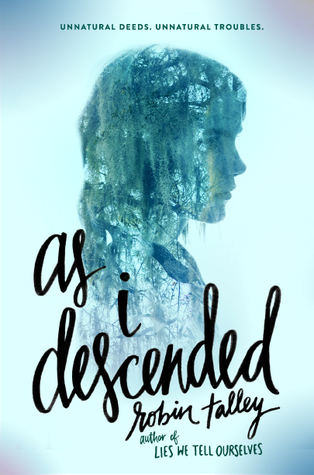
by Robin Talley
My Rating:

Maria Lyon and Lily Boiten are their school’s ultimate power couple—even if no one knows it but them.
Only one thing stands between them and their perfect future: campus superstar Delilah Dufrey.
Golden child Delilah is a legend at the exclusive Acheron Academy, and the presumptive winner of the distinguished Cawdor Kingsley Prize. She runs the school, and if she chose, she could blow up Maria and Lily’s whole world with a pointed look, or a carefully placed word.
But what Delilah doesn’t know is that Lily and Maria are willing to do anything—absolutely anything—to make their dreams come true. And the first step is unseating Delilah for the Kingsley Prize. The full scholarship, awarded to Maria, will lock in her attendance at Stanford―and four more years in a shared dorm room with Lily.
Maria and Lily will stop at nothing to ensure their victory—including harnessing the dark power long rumored to be present on the former plantation that houses their school.
But when feuds turn to fatalities, and madness begins to blur the distinction between what’s real and what is imagined, the girls must decide where they draw the line.
I received an eARC of As I Descended from NetGalley in exchange for an honest review. Check out my reviews of Lies We Tell Ourselves and What We Left Behind here and here!
So, lesbians and Macbeth anyone?
I've been following Robin Talley since I read and enjoyed her debut, Lies We Tell Ourselves, a couple of years ago; it was refreshing to find a new voice for LGBT+ women in the world of YA, and when I heard her third novel would be a modern, lesbian retelling of Macbeth - my favourite of Shakespeare's plays - I knew I had to get my hands on a copy.
Considering the kind of retelling this is, I think it's a clever one. Out of all of Shakespeare's plays, Macbeth certainly isn't the first to jump out as being the best story to retell in the setting of an American high school for no other reason than that it's difficult to imagine its cast of characters as teenagers; Macbeth and Lady Macbeth are married, and many of their friends (and their enemies) have their own children. Talley did a pretty good job at converting one of Shakespeare's darkest stories into a high school setting and I think she should be commended for it. It was easy to tell who each character was meant to represent from the original text, and making the school a boarding school was a brilliant choice by Talley as a way to get these kids' parents out of the way when things start to get out of hand.
One of the things I really appreciated was that you don't have to know Macbeth well to enjoy this story. I love Macbeth, but I can appreciate that a lot of people out there feel intimidated by Shakespeare and may be wary about picking a retelling up - if you're one such person, you needn't be! The tips of the hat to Macbeth are there for those who'll recognise them, but the book can be enjoyed by anyone regardless of their Shakespearean knowledge.
The thing I probably enjoyed most about As I Descended is how it explored the same themes that Macbeth does - our relationship with guilt and what we're willing to take into our own hands when we feel as though we're not getting what we deserve, and ultimately getting what we deserve because we take things into our own hands - and did so in such a way that really fit its setting. The competitiveness in As I Descended is the kind I'd expect to find in a school for the wealthy, where your days are spent trying to get the most scholarships and awards, whether you work hard for them or just happen to be sleeping with the right teacher.
That this is a lesbian retelling of Macbeth is all the better, in fact I think this is the first LGBT+ retelling of one of Shakespeare's plays I've encountered and it's made me want to seek out more. There must be more out there! My only complaint in regards to Maria and Lily's relationship is that I would have liked to have known more about how they met and why they were together; I believed their chemistry, and I loved that the fact that their relationship was an LGBT+ one wasn't the focus of the plot, I just wanted to know more about where it started.
In fact I'd've liked to have known more about all of the characters, as for the most part I didn't feel as though I got to know any one of them particularly well and that was mainly because of the way it was written. Both of Talley's previous novels have been told from the points of view of the two main protagonists, in alternating chapters, whereas As I Descended flits from character to character to character, often in the middle of chapters, and it left me unable to really get to know any one character in particular. Unlike her previous books, As I Descended is also the first of Talley's books that's written in third person and I got the feeling she wasn't quite as comfortable writing in third person as she is in first person because she flitted from one character to the next so often.
I was also disappointed with the lack of witches in this book. I love me some witches, and whenever I come across an adaptation of Macbeth one of the things I'm most interested in is how the witches are portrayed. As I Descended was fairly clever in that it's revealed Maria has been able to speak to spirits since she was a little girl and the novel opens with herself, Lily (Lady Macbeth) and Brandon (Banquo) playing with a ouija board, thus it's spirits who give Maria their prophecy and subsequently cause a lot of mischief.
I had an issue with this for a couple of reasons: firstly, I was just disappointed they weren't witches and I thought there easily could have been a way around that if they were the spirits of women who'd been executed for witchcraft. Secondly, the story began to suggest that the characters wouldn't do the things they were doing if it weren't for the spirits. Now that's true to the initial plot to an extent - Macbeth only kills Duncan because the witches tell him he'll be King after his death and it turns into a self-fulfilling prophecy - but in As I Descended the spirits continued to pop up and influence people's decisions, and I couldn't help feeling that Talley was trying to make her characters a little more sympathetic by implying it wasn't really they who were 'bad', but the whole point of Macbeth is that these characters make a terrible decision all by themselves and then suffer with the guilt of that decision. Not that they're driven to madness by witches, because all the witches do is tell them the future - it's up to Macbeth and co. how they interpret it.
The spirits certainly fit into the Southern Gothic feel of As I Descended; there's an old story that a rich family once lived on the same land the school has been built on, and one day the patriarch went mad, locked his family and their slaves in a building and then set fire to it, but I wasn't sure if that story needed to be there. The spirits of angry slaves punishing the children of the modern-day wealthy elite might have been more satisfying if it weren't for the fact that a lot of the main characters weren't white themselves, and often it was the ghosts of the family rather than the ghosts of the slaves who were causing the trouble so the whole backstory just felt a little confused to me.
My biggest problem with the story, however, was motivation. I loved the little allusions to the original story such as Maria becoming the Prom Queen instead of Delilah, a fun, modern-day tip of the hat to Macbeth becoming King after Duncan, but the reasoning behind Maria and Lily's attack on Delilah just seemed rather weak to me. Maria wants to win a scholarship that only one student can get which will make sure she can get into her college of choice, and that means going to college with Lily where the two of them can be open about their relationship. This will subsequently mean Delilah doesn't get the scholarship because she doesn't deserve it; while Maria has been studying and working hard throughout school, Delilah has been riding high on her parents' money and sleeping with her teachers.
I get why they'd want Delilah to be punished, it can be hard to see someone else be rewarded when you know you've worked harder, but Maria doesn't really seem to need that scholarship. Her family's hardly poor so it's not like she can't afford to go to college, and her grades are so good I don't see why a scholarship would stop whichever college she wants to go to from taking her on. Plus does she have to go to college with Lily? It'd be nice, sure, but there's no reason why they couldn't go to different colleges and stay together. Clearly priorities are different in this school environment and the scholarship is a big deal, but I'm not sure it's worth everything that happens in this book. Maybe that's the point: is Macbeth's reign worth it when it's doomed from the start?
Ultimately I didn't like this as much as I wanted to, but I did enjoy it and I would recommend it. I still think Talley is a very important voice in the YA world and I'll continue to read her work in future. If you're not a huge Macbeth fan I think you'll really enjoy this, and if you are a Macbeth fan I think you might be a little more nit-picky - but it's still worth reading!


