
When it comes to horror, writers like Stephen King, James Herbert and H.P. Lovecraft are probably some of the first to spring to mind, but women have been at the centre of horror since horror began.
It was eighteen year old Mary Shelley who penned Frankenstein, and Carmilla was terrorizing young maidens in their beds a quarter of a century before Dracula washed up on the Whitby shore. The protagonists of Gothic novels are primarily young women trapped in eerie houses with limited and frightening prospects, and it’s a trope that continues to influence us, from the Alien franchise’s Ellen Ripley to Edith Cushing, the heroine of Guillermo del Toro’s latest film, Crimson Peak.
Needless to say, there’s no shortage of women in horror, whether they be in the starring roles or the orchestrator of all that chaos.
Though most famous for her comedy of manners stories, Austen’s first completed novel, Northanger Abbey, was a parody of the Gothic novels she was most likely reading at the time. Pride and Prejudice is widely considered to be Austen’s masterpiece, but personally I’ve always preferred the story of the young, obsessive reader who lets her imagination get the better of her.
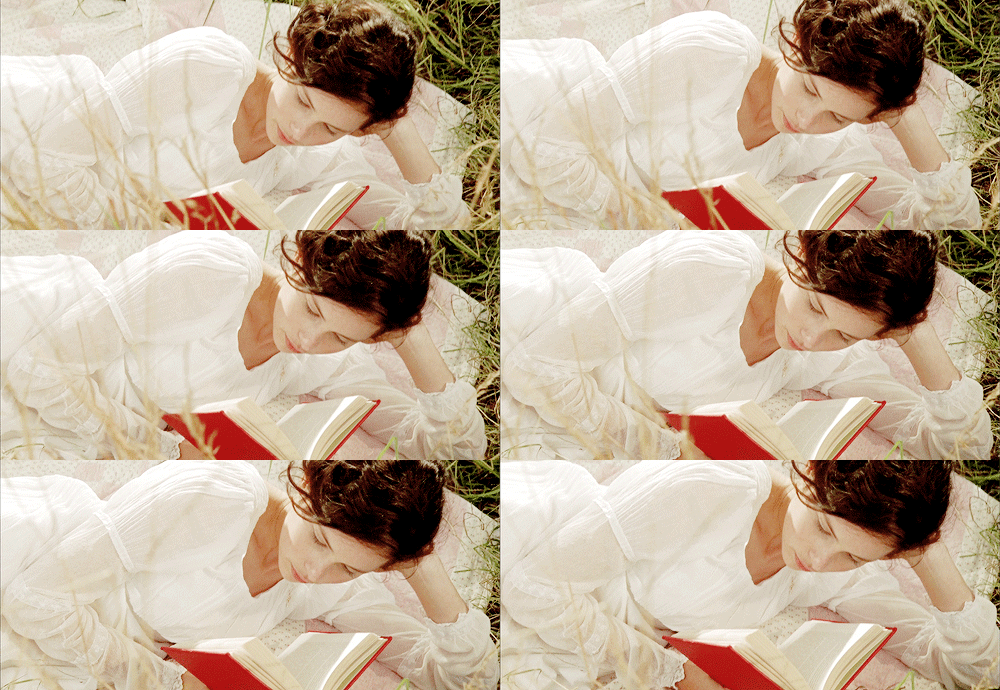
‘Silly’ is a word I often see thrown about when describing Catherine, and to be honest I think it's unfair. Catherine is naïve, gullible and imaginative, but never silly. You see, I’m not sure that Northanger Abbey really is a parody.
Catherine’s no saint; she makes (some rather hurtful) assumptions that lead to embarrassing consequences, making her, like all of Austen’s heroines, an ancestor of today’s Bridget Joneses and Carrie Bradshaws. Upon first meeting General Tilney, Catherine casts him as the villain in her own personal story. He’s the cold, calculating man who so values wealth that poor, dowerless Catherine is certain she’ll never be able to marry his son, Henry, unless the two of them romantically run off into the sunset.
Naturally she’s surprised when the General invites her to his home, Northanger Abbey, and the Gothic fangirl in Catherine simply can’t resist the opportunity to stay in a place that sounds as though it belongs in one of her favourite novels. Unfortunately, the Gothic fangirl in Catherine also comes to the conclusion that the General murdered his wife. Oh dear.
Ultimately Catherine learns her lesson and resolves not to let herself get carried away by the novels she loves. She and Henry marry and have a baby, leaving Catherine in a state of domestic bliss as the novel comes to a close.
That’s all well and good, but there’s more to this novel than a young girl learning from her mistakes. It’s true that Catherine is wrong about the General murdering his wife, but she isn’t wrong about him. The General proves to be a villain not only in the way he treats Catherine, but in the way he treats his own family; Henry himself admits that while his father is no murderer, his mother was so unloved that the General’s treatment of her certainly hastened her arrival at the pearly gates.
Northanger Abbey is haunted in much the same way that Thornfield Hall and Manderley are; Rebecca de Winter might not be visible, but she is very present throughout Rebecca, and Bertha Mason quite literally haunts the attic of Thornfield, so much so that the servants mistake her for a ghost. Mrs Tilney’s rooms are closed up and disused, as though the very memory of her has been banished to a solitary part of the house. Northanger Abbey is a living museum of domestic unhappiness.
There may not be murder, scandal or supernatural creatures in Northanger Abbey, unlike many of the other pre-Victorian examples of Gothic literature, such as Mary Shelley’s Frankenstein and Matthew Lewis’s The Monk, but there is a quieter horror at work here that would have seemed much more real to Austen and the other women of her day.
Mrs Tilney’s fate was one which befell many women whose husbands married them for their wealth alone, and then treated them like breeding mares. Just like today, many marriages during the Regency period would have been happy ones, but the unhappy ones were very unhappy. Back then women had even less rights than today; they couldn’t vote, often weren’t granted a divorce when they were brave enough to seek one, and signed over everything they owned to their husbands when they were married.
Catherine may read the situations around her through a Gothic lens, but the conclusion she comes to - that General Tilney is a villain (of sorts) - is ultimately correct. She recognises that Mrs Tilney was the victim of a miserable marriage, and in doing so Austen rewards her with a happy one of her own.


